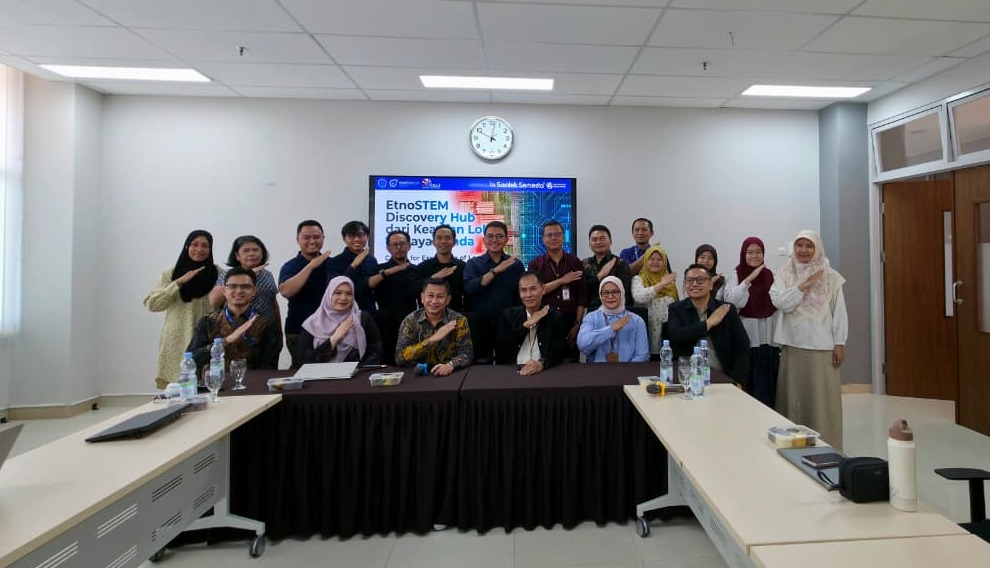
BANDUNG, Indonesia — The Center for Excellence in Learning and Lesson Studies (CELLS) at Universitas Pendidikan Indonesia (UPI) held a Monitoring and Evaluation (Monev) meeting with the Ministry of Higher Education, Science, and Technology (Kemendiktisaintek) as part of the In-Saintek Program. The meeting discussed the development of the EthnoSTEM Discovery Hub based on Sundanese cultural local wisdom. The activity took place in the Meeting Room on the 5th Floor of the Center of Excellence (COE) UPI.
The meeting was part of the implementation support for the In-Saintek Program. In the opening session, representatives of Kemendiktisaintek emphasized the importance of team strength, community involvement, and program sustainability as key achievements that need to be maintained throughout the program.
Lina Aviyanti, M.Si., Ph.D., as the Program Chair, presented the development of EthnoSTEM, which aims to explore and document the uniqueness of Sundanese culture through the Science, Technology, Engineering, and Mathematics (STEM) approach. One of the main focuses is Rasi, which is closely connected to the food identity of the Cireundeu community.
The development of Rasi is being continued through several derivative products that are still at the prototype development stage, namely Trasmie (Tepung Rasi Mie), Trasbar (Tepung Rasi Bar), and Trascuit (Tepung Rasi Biscuit). According to the CELLS team, these products are being developed to introduce Rasi to a broader audience, including younger generations.
In addition to food product development, EthnoSTEM includes Buka Kelas EtnoSTEM, which explores traditional Sundanese musical instruments, including karinding, celempung, and angklung buncis. The activity is intended to produce bilingual teaching modules as part of the documentation and dissemination of culture-based learning.
The program also develops Eco-Engineering through studies of the local environment and traditional houses, including woven patterns used as walls, house construction on sloping terrain, and the development of eco-bricks as an alternative building material.
As part of the implementation, students are involved in EthnoSTEM projects outside regular classroom learning. The project outcomes are planned to be presented through a showcase as part of efforts to broaden the dissemination of culture-based learning. One of the locations discussed for the activity was the Gasibu area.
Maintaining the Connection with Cireundeu
During the feedback session, Dr. Anton Timur Jaelani, S.Si., M.Si., from Kemendiktisaintek, emphasized the need for further communication with community elders or knowledge holders in Cireundeu regarding the development and commercialization of Rasi-derived products. He also emphasized the importance of presenting the identities of UPI and Cireundeu in a balanced manner in the product development process.
In response, Arif Hidayat, M.Si., Ph.D., Head of CELLS UPI, explained that the Cireundeu community is positioned as the owner of the knowledge, and that the program is being developed through a co-creation approach. According to him, the development of EthnoSTEM is intended to build a collaborative process with the community while expanding the exploration of Sundanese local wisdom, which is the focus of the program.
Satria Yudha Herawan from Kemendiktisaintek also emphasized that Cireundeu needs to remain an important part of the program’s continued development. He highlighted the importance of ensuring that product development continues to involve the Cireundeu community and environment, and that the results of the study provide benefits back to the community.
Strengthening the Roadmap and Sustainability
In discussing sustainability, representatives of Kemendiktisaintek encouraged the preparation of a clearer roadmap to map the various development potentials of EthnoSTEM and establish program priorities. Existing partnerships were also considered important to maintain so that collaboration can continue after the In-Saintek period ends.
Panji Akbar from Kemendiktisaintek gave particular attention to the sustainability of Rasi and the potential for disseminating the product more broadly. The development of Rasi was discussed in relation to food security, making sustainability and wider outreach important aspects to consider.
Dr. Eni Nuraeni, M.Pd., stated that the products Trasmie, Trasbar, and Trascuit are still at the prototype development stage and continue to be directed toward broader public introduction, particularly among younger generations. Meanwhile, Lina Aviyanti explained that several second-year developments are continuations of activities from the previous year, including the development of eco-bricks, which will be further examined in terms of material composition and strength.
Dr. Lili Adi Wibowo, S.Pd., S.Sos., and Ari Arifin Danuwijaya, S.Pd., M.Ed., Ph.D., were also among the key participants attending the meeting between Kemendiktisaintek and CELLS.
Through this Monitoring and Evaluation meeting, CELLS UPI and Kemendiktisaintek continued discussions on the direction of the EthnoSTEM Discovery Hub, with attention to strengthening the roadmap, sustaining partnerships, involving the Cireundeu community, and developing learning innovations that integrate local wisdom with the STEM approach.